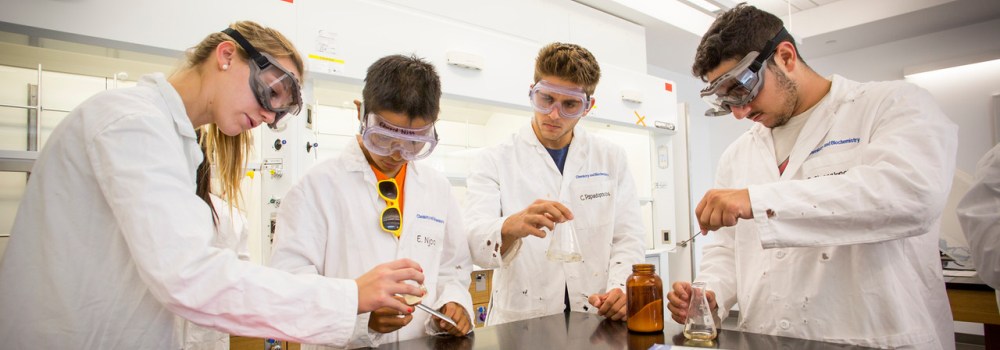
The Department offers Bachelor of Science degrees in Chemistry or Biochemistry. The BS degree in Chemistry is approved by the Committee on Professional Training (CPT) of the American Chemical Society (ACS). With the addition of one course, the BS degree in Biochemistry can be certified by the ACS.
-
There are two tracks available in the biochemistry major, ACS-certified track and General track.
The Bachelor of Science degree program, approved by the Committee on Professional Training of the American Chemical Society (ACS), ACS certified track in Biochemistry, is designed to prepare the student not only for immediate entry into the profession of biochemistry at the Bachelor's level but also for graduate study toward advanced degrees.
The Bachelor of Science degree program, General track in Biochemistry, provides the student with a flexible program that builds upon a solid fundamental knowledge in chemistry and biochemistry. Students work with their advisors/chairperson to select upper division elective courses in emphasis areas like health sciences - which include but are not limited to medicine, pharmacy, dentistry, optometry - and areas such as forensics, environmental chemistry, education, etc.
-
There are two tracks available in the chemistry major, ACS-certified track and General track.
The Bachelor of Science degree program, approved by the Committee on Professional Training of the American Chemical Society (ACS), ACS-certified track in Chemistry, is designed to prepare the student not only for immediate entry into the profession of chemistry at the Bachelor's level but also for graduate study toward advanced degrees.
The Bachelor of Science degree program, General track in Chemistry, provides the student with a flexible program that builds upon a solid fundamental knowledge in chemistry. Students work with their advisors/chairperson to select upper division elective courses in emphasis areas like health sciences - which include but are not limited to medicine, pharmacy, dentistry, optometry - and areas such as forensics, environmental chemistry, education, etc.
-
Requirements
- BIOL 101 General Biology I 3 semester hours
- BIOL 111 General Biology I Lab 2 semester hours
- BIOL 201 Cell Function 3 semester hours
- BIOL 202 Genetics 3 semester hours
- CHEM 1100 General Chemistry I 3 semester hours
- CHEM 1110 General Chemistry I Lab 1 semester hours
- CHEM 1120 General Chemistry II 3 semester hours
- CHEM 1130 General Chemistry II Lab 1 semester hours
- CHEM 2200 Organic Chemistry I 3 semester hours
- CHEM 2210 Organic Chemistry I Lab 1 semester hours
- CHEM 2220 Organic Chemistry II 3 semester hours
- CHEM 2230 Organic Chemistry II Lab 1 semester hours
- CHEM 3700 Biochemistry 3 semester hours
And 4 additional upper division semester hours selected from:
- CHEM 371 Biochemistry Lab 1 semester hours
- CHEM 372 Advanced Biochemistry 3 semester hours
- CHEM 373 Advanced Biochemistry Lab 1 semester hours
- CHEM 434 Bioinorganic Chemistry 3 semester hours
- CHEM 476 Advanced Topics in Biochemistry and Biotechnology 3 semester hours
- CHEM 478 Introduction to Virology 3 semester hours
- CHEM 480 Medicinal Chemistry 3 semester hours
- CHEM 482 Toxicology 3 semester hours or
- Other advanced biochemical elective including one upper division laboratory course.
Note:
These must be selected under the direction of the Chairperson of the Department. CHEM 370 and other upper division courses used for the minor cannot also count toward the individual's major. A grade of C (2.0) is required for CHEM courses included in the lower division requirements of the minor. An average grade of C (2.0) is required for all other courses included in the requirements of the minor. -
Requirements
- BIOL 101 General Biology I 3 semester hours
- BIOL 111 General Biology I Lab 2 semester hours
- CHEM 1100 General Chemistry I 3 semester hours
- CHEM 1110 General Chemistry I Lab 1 semester hours
- CHEM 1120 General Chemistry II 3 semester hours
- CHEM 1130 General Chemistry II Lab 1 semester hours
- CHEM 2200 Organic Chemistry I 3 semester hours
- CHEM 2210 Organic Chemistry I Lab 1 semester hours
- CHEM 2220 Organic Chemistry II 3 semester hours
- CHEM 2230 Organic Chemistry II Lab 1 semester hours
- A minimum of 7 upper division semester hours of CHEM courses including one upper division laboratory course.
Note:
These must be selected under the direction of the Chairperson of the Department. Upper division chemistry courses used for the minor cannot also count toward the individual's major.
A grade of at least C (2.0) is required for CHEM courses included in the lower division requirements of the minor. An average grade of C (2.0) is required for all other courses included in the requirements of the minor.
No chemistry minor is available in conjunction with a biochemistry major. It is suggested that the student interested in in-depth study of both subjects should major in chemistry and minor in biochemistry.
-
Chemistry (CHEM)
- CHEM 1100 General Chemistry I
- CHEM 1110 General Chemistry I Lab
- CHEM 1120 General Chemistry II
- CHEM 1130 General Chemistry II Lab
- CHEM 1140 General Chemistry for Engineers
- CHEM 1900 World of Chemistry and Biochemistry
- CHEM 1998 Special Studies
- CHEM 1999 Independent Studies
- CHEM 2200 Organic Chemistry I
- CHEM 2210 Organic Chemistry I Lab
- CHEM 2220 Organic Chemistry II
- CHEM 2230 Organic Chemistry II Lab
- CHEM 2250 Organic Chemistry II Lab for Molecular Sciences
- CHEM 2500 Earth System Science
- CHEM 2620 The Chemical Environment
- CHEM 2700 Frontiers of Science
- CHEM 2720 Biotechnology in the News
- CHEM 2900 Chemistry Seminar
- CHEM 2998 Special Studies
- CHEM 2999 Independent Studies
- CHEM 3300 Inorganic Chemistry
- CHEM 3310 Inorganic Chemistry Lab
- CHEM 3400 Physical Chemistry
- CHEM 3410 Physical Chemistry Lab
- CHEM 3420 Advanced Physical Chemistry
- CHEM 3430 Advanced Physical Chemistry Lab
- CHEM 3460 Physical Biochemistry
- CHEM 3470 Physical Biochemistry Lab
- CHEM 3560 Sustainable Practices
- CHEM 3570 Environmental Chemistry: Atmosphere and Climate
- CHEM 3580 Environmental Chemistry: Water, Soil, and Sediment
- CHEM 3590 Environmental Chemistry Laboratory
- CHEM 3600 Analytical Chemistry and Lab
- CHEM 3700 Biochemistry
- CHEM 3710 Biochemistry Lab
- CHEM 3720 Advanced Biochemistry
- CHEM 3730 Advanced Biochemistry Lab
- CHEM 3800 Forensic Chemistry
- CHEM 3820 Wine Chemistry
- CHEM 3900 Chemistry Seminar
- CHEM 3910 Chemistry Seminar
- CHEM 3930 Chemistry/Biochemistry Internship
- CHEM 3970 Directed Research
- CHEM 3998 Special Studies
- CHEM 3999 Independent Studies
- CHEM 4200 Advanced Organic Chemistry
- CHEM 4210 Advanced Organic Chemistry Lab
- CHEM 4220 Physical Organic Chemistry
- CHEM 4300 Advanced Inorganic Chemistry
- CHEM 4340 Bioinorganic Chemistry
- CHEM 4600 Instrumental Analysis and Lab
- CHEM 4740 Food Chemistry
- CHEM 4760 Advanced Topics in Biochemistry and Biotechnology
- CHEM 4780 Introduction to Virology
- CHEM 4800 Medicinal Chemistry
- CHEM 4820 Toxicology
- CHEM 4900 Chemistry Seminar
- CHEM 4910 Chemistry Seminar
- CHEM 4930 Chemistry/Biochemistry Internship
- CHEM 4950 Chemistry Teaching
- CHEM 4970 Directed Research
- CHEM 4998 Special Studies
- CHEM 4999 Independent Studies
- CHEM 5600 Introduction to Modern Spectroscopy
-
Student learning outcomes for the chemistry and biochemistry majors:
- Students will be able to apply essential concepts in chemistry and biochemistry.
- Students will be able to complete an experiment in the chemistry/biochemistry laboratory using safe and proper technique.
- Students will be able to analyze and present data in written and oral formats.
- Students will be able to argue why chemistry and the application of green chemistry principles is an integral activity for addressing social issues such as economic, health and/or environmental problems.